Simply Wall St Review: Researching ASX & Global Shares

I've been using Simply Wall St as part of my research process for several years. I don't use it to make decisions for me, and I don't believe any platform should be followed blindly. What I do find useful is how quickly it helps me understand what a business does, compare companies, identify potential opportunities and spot areas that deserve a deeper look.
In other words, I see it as a starting point, not an ending point. It helps me organise information and ask better questions, but the final decision is always mine.
And that's really why a platform like this is worth talking about before we get into stock examples, company analysis, valuation, dividends or any investing method. Because there's a more basic question to answer first: where do you actually find companies to research in the first place? You can't analyse a company if you don't know where to find the information. You can't compare businesses without the numbers in front of you. And you can't filter the market properly without a tool that helps you organise what you're looking at.
Throughout this post I'll use CSL Limited (ASX: CSL) to show what the visuals actually look like. CSL is an illustrative example only — it is not a recommendation to buy, sell or hold, and nothing here is personal financial advice. It's simply a well-known Australian company that makes the screenshots easy to follow.
> One important caveat up front: Simply Wall St isn't the only platform I use, and I don't think any investor should rely on one website, one app, one spreadsheet or one opinion alone. Different platforms show data in different ways, so I cross-check. Treat this as one tool in the process — not the whole process.
WHAT IS SIMPLY WALL ST?
Simply Wall St is an Australian company, founded in Sydney, that gives investors a more visual way to research companies and track portfolios. It covers Australian shares, US shares and many other markets, so you can look at ASX companies and international companies in one place.
THE SNOWFLAKE — A FAST FIRST LOOK
The first thing most people notice is the Snowflake: a visual summary of a company across five areas — valuation, future growth, past performance, financial health and dividends.

I want to be careful here: the Snowflake isn't a buy signal, it isn't a sell signal, and it isn't the final answer. It's a starting point. Instead of opening a full company report and getting lost straight away, it gives me a quick first read of where a company might look strong and where I may need to be more careful.
Maybe the company looks cheap, but the financial health isn't great. Maybe it has strong growth but no dividends. Maybe the past performance looks strong but the valuation looks stretched. None of that tells me what to do by itself — but it tells me where to look next. I use it like a map: it points me in a direction, but I still have to do the thinking.
HOW I USE SIMPLY WALL ST IN THE OUTBACK INVESTOR METHOD
People often ask whether Simply Wall St tells me what to buy. The answer is no. My process usually looks something like this:
Step 1: Understand the business. Before looking at numbers, I want to understand what the company actually does. How does it make money? Who are its customers? What could go right? What could go wrong?
Step 2: Review the Snowflake. A quick overview of valuation, growth, financial health, dividends and past performance — it helps me identify areas that may deserve a closer look.
Step 3: Check financial strength. I review the balance sheet, debt levels and overall financial health. A great business can still become a poor investment if its finances are weak.
Step 4: Review dividends and income. If income is part of the thesis, I look at dividend history, payout ratios and sustainability. A high yield alone is never enough.
Step 5: Compare valuation. Valuation is one piece of the puzzle. A great company can be a poor investment if bought at the wrong price.
Step 6: Cross-check other sources. I don't rely on a single platform — I also review company announcements, annual reports, investor presentations and other research.
Step 7: Make my own decision. No website, app, analyst or YouTuber can remove risk from investing. Every decision ultimately belongs to the investor.
That's why I consider Simply Wall St a useful tool within the process, but never the entire process.
VALUATION — AN ESTIMATE, NOT THE TRUTH
Simply Wall St estimates whether a company may be undervalued or overvalued based on its model. I don't treat that number as fact — a valuation model is only an estimate, and it depends on assumptions that can be wrong. But it's a useful starting point.

What I like even more is being able to compare a company against others in the same industry or sector. A business can look cheap on its own, until you compare it to the sector and realise the whole sector is cheap. Or it looks expensive, but it's growing faster, has better margins and a stronger balance sheet than its competitors. That's where the platform helps me ask better questions — and in investing, better questions matter.
WATCHLISTS AND ALERTS
Say there's a company I'm interested in but I don't like today's price. I can add it to a watchlist and set a price or valuation level where I'd become more interested, then get an alert if it gets there.

That's useful because I don't want to react to every headline or invest just because something is trending. I'd rather keep a list of companies I'm watching, set my own levels, and come back when there's an actual reason to look again.
THE SCREENER — FINDING COMPANIES YOU DIDN'T KNOW EXISTED
The screener lets you build filters — dividend yield, valuation, debt, growth, market, industry and more. Instead of searching for a company you already know, you search for the type of business you're after.


Sometimes you only know the big names — the banks, the miners, the companies everyone talks about. A screener can surface businesses in other industries you'd never search for by name. That doesn't make them good investments; it just means they may be worth researching. And that's enough for a first step.
PORTFOLIO TRACKING AND DEMO PORTFOLIOS
You can connect some brokers directly (many are supported worldwide), though not all — from what I've seen, Betashares Direct isn't currently supported, for example. Where there's no direct connection, you can import holdings via a CSV file. It's a bit more effort, but it still works.
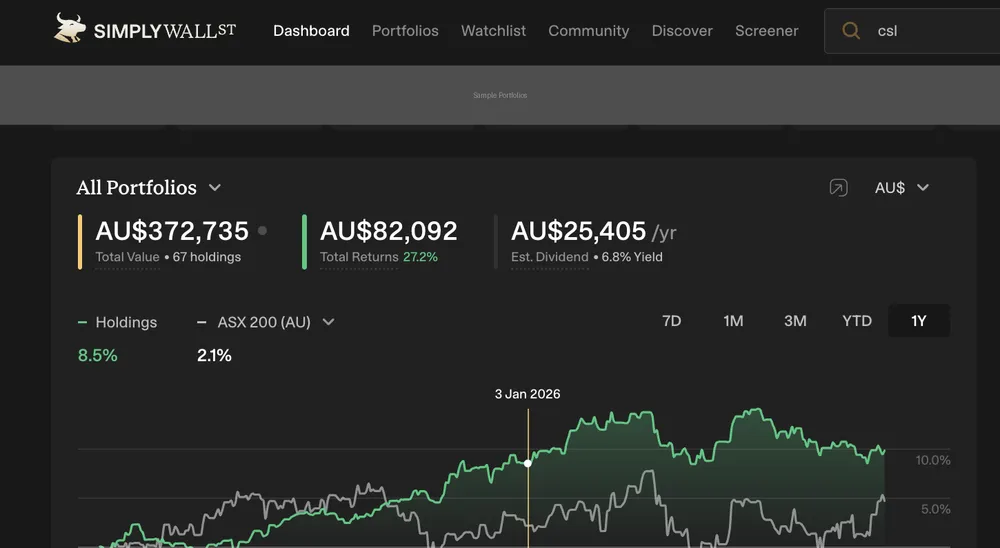
I also like demo portfolios, because you can test an idea before putting real money in — compare one idea against another, or see how a group of companies performs against a benchmark like the ASX 200 or S&P 500. It helps you slow down and think before acting. Investing isn't only about finding ideas; it's also about not rushing into every one. Seeing the equity curve over time helps too — one day, one week, even one month doesn't mean much, but over time you want to see whether your strategy is actually moving the way you expected.
DIVIDENDS
For income-focused investors, Simply Wall St can estimate expected dividends across a portfolio and show your expected income. I'd still cross-check it — dividends change, companies cut them, special dividends may not repeat, and forecasts can be wrong — but as a portfolio-level view, I find it helpful.

MANAGEMENT — ARE THEY ALIGNED WITH SHAREHOLDERS?
One feature I personally value is the management section. You can see the management team, how executives are paid, and how that pay compares with similar companies.

I've got no problem with executives being paid well. If someone is running a strong business and creating long-term value, and their pay is in line with the industry, that can be fair. What I want to know is whether management appears aligned with shareholders: is the pay reasonable compared with similar businesses, and is the company performing? When you invest in a company, you're not just looking at numbers on a screen — you're trusting the people running the business.
WHAT I LIKE — AND WHAT TO WATCH
What I like most: it's visual and easy to follow, the Snowflake gives a fast first look, I can compare companies within a sector, the watchlists and screener help me discover and track ideas, and the portfolio, demo-portfolio and dividend tools are genuinely useful. It's Australian-built but has global reach.
What to be careful with:
- Don't use it as your only research tool.
- Don't treat the Snowflake as a buy or sell recommendation.
- Remember valuation models are estimates, not facts.
- Some features may require a paid plan.
- Not every broker connects directly — you may need a CSV import.
- Always cross-check: use other platforms, read company reports, look at broker data, compare numbers, and think for yourself.
WHO IT'S FOR — AND WHO IT'S NOT FOR
Who it's for:
- Investors who want a visual way to research companies.
- Beginners learning how to analyse shares.
- Investors managing multiple portfolios or watchlists.
- People who want a faster way to compare companies before deeper research.
- Long-term investors who enjoy understanding the businesses they own.
Who it's not for:
- Traders looking for live buy and sell signals.
- Investors wanting someone else to make decisions for them.
- People expecting software to guarantee investment returns.
- Anyone unwilling to do their own research and due diligence.
Like any investing tool, its value depends on how you use it. The platform can help organise information, but it cannot replace critical thinking.
MY OVERALL TAKE
Simply Wall St is one of the better tools I've found for making stock research feel less overwhelming. It doesn't do everything, it's not perfect, and I wouldn't make a decision based on one platform alone. But as a starting point, a portfolio tracker, and a way to discover companies and ask better questions, I think it's useful. For beginners it makes research less intimidating; for more experienced investors it saves time and organises ideas. I use it as part of my process — not as the whole process. And that's why I'm starting here: before we can talk about filtering companies, analysing shares or applying any method, we need somewhere to find the information.
------------------------------------------------------------
WANT TO SEE WHAT YOUR OWN PORTFOLIO LOOKS LIKE?
Simply Wall St offers a portfolio demo where you can explore the platform before committing — that's usually the best place to start.
Explore Simply Wall St: https://goto.simplywall.st/YVbNkr (affiliate link) — I may receive a commission if you sign up through this link, at no extra cost to you.
You can also see the wider list of platforms I use and mention across the site on the Outback Investor Platforms page: /platforms
------------------------------------------------------------
IMPORTANT — EDUCATIONAL ONLY. This article contains affiliate links. If you sign up through one of these links, I may receive a commission at no additional cost to you. I only promote products and services that I personally use or believe may provide value to investors. This content is general information only and does not constitute personal financial advice, and is not a recommendation to buy, sell or hold any financial product. CSL Limited is used purely as an illustrative example to demonstrate the platform's features. My opinions are my own. Your goals, risk tolerance, financial situation and timeframe may be completely different from mine. Before making any investment decision, do your own research and consider speaking with a licensed financial adviser.


